








| Studio #tba Wize Owl Handprints Hand-Carved and Hand-Printed Wood and Linoleum Block Prints by Amy Grogan Go to Wize Owl Handprints' Website! 39675 County Road J, Mancos 970-799-2469 This artist will be participating in the studio tour during the First Weekend Only! September 19 & 20 |
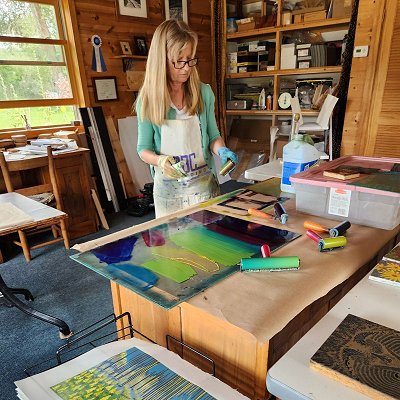 |
Amy Grogan was born and raised in Milwaukee, Wisconsin. Following graduation with a Bachelor of Fine Arts degree from the School of the Art Institute of Chicago, Amy moved to the Southwest where her work has reflected the wilderness landscapes and Western native wildlife. Amy has explored the Four Corners backcountry for over 30 years, in addition as a volunteer backcountry ranger at Canyonlands National Park and at Mesa Verde National Park.
She has been represented by McNair Gallery and Golden West Gallery in Telluride as well as owning a fine art gallery, Grogan Fine Art in Silverton, Colorado. She illustrated a wildlife and botanical book, written by Dr. Povilitis, “Slipping Through Our Hands: Imperiled Wildlife of the Greater San Juans.”
After Amy sold her fine art gallery, she and her husband moved to Mancos, Colorado to a small farm where she set up her printmaking studio at the base of Mesa Verde National Park. In 2010, she had a solo, sold out show of her block printed work at the Petite Galerie du Musee in La Brigue, France. Since then she has concentrated on her unique, limited edition, block prints under the name, Wize Owl Handprints.
In 2022 her block print, “Mineral Blues” was awarded First Place at the Ouray Alpine Art Show. Also in 2022 Amy was spotlighted for ShoutOut Colorado, an online platform highlighting Colorado artists. She was commissioned to design a block print of the Twilight Peaks with the San Juan Mountains Association for their “Wild for the Weminuche” wilderness campaign. She has also created commissions with the Mountain Studies Institute and Rocky Mountain Wild.
In 2019 Amy was awarded an art residency with the Pike Isabel National Forest near Buena Vista and has done art residencies with Canyons of the Ancients National Monument and the San Juan National Forest, all in Colorado. In April 2023 Amy completed an art residency with Capitol Reef National Park. She is represented by The Torrey Gallery in Torrey, Utah.
ARTIST STATEMENT:
Being a fine artist, I partially make my living depicting wildlife images & the other half from the wild landscape. The inherent existence of wild creatures & their native habitat, in essence, has been my focus for 3 decades so the health of the planet’s creatures and where they choose to live is extremely important to me. My work, I hope, is a retrospect of our native roots and a reminder of what should be crucial to our community, our states, our country and ultimately the planet.
As a landscape and wildlife artist I get my inspiration for new images from the outdoors, whether it's the top of the mountain, in the deep forests leading up to the top or in the canyon bottoms. The different ecological zones at different elevations have their unique characteristics and animals that live there, sometimes overlapping from one zone to the other. Over the years I have observed and compared these unique life zones from one mountain range to the next and am fascinated by nature's resiliency and grandeur. I love exploring new trails, new peaks and new corners of nature that are I am unfamiliar with. It continually reminds me how vast our public lands are and that I am fortunate to be able to enjoy these wild places set aside by forward thinking pioneers for future generations to experience and be inspired. I have donated my artwork for local, environmental causes as a way of giving back to these treasured landscapes. By being a good steward I make it my mission to help to support protecting the environment in my own backyard.
Slow printing is almost an act of defiance these days against our digital onslaught that seems to be taking over our lives bit by byte every day, every year. The response I typically get from viewing my block prints is the shock from the richness of the colors. The public is amazed at the density of color that is achieved from the antiquated slow process of analog historic printing. I tell them that if they were to look at my hand pulled prints with a magnifying lens it would show a dense color field, not a field of digital dots. It is a concept that most people have trouble imagining or maybe even do not care about. But why is it important? Because sometimes the original technology is better. You do not need a machine (generated by power) to get exceptional results. My work is totally hand powered and a relic of a bygone era.
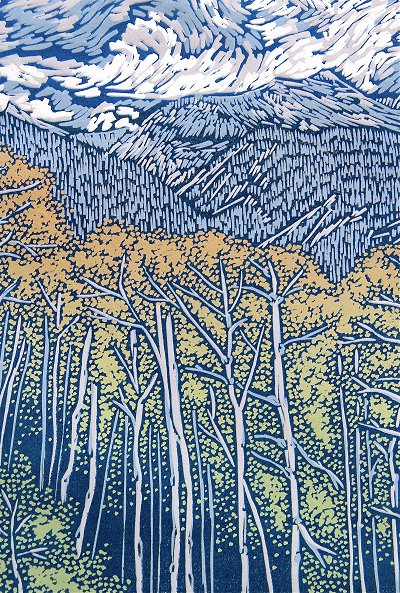
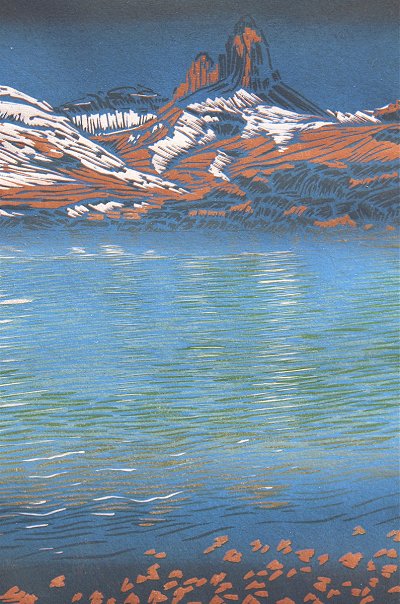
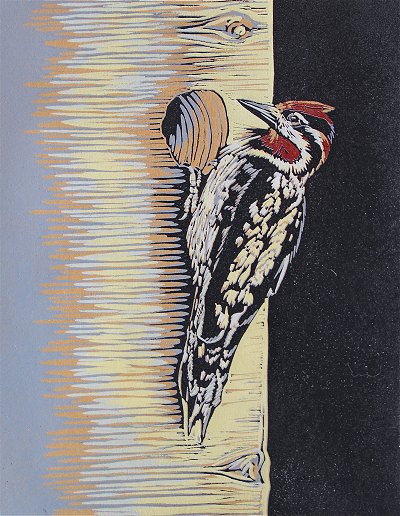
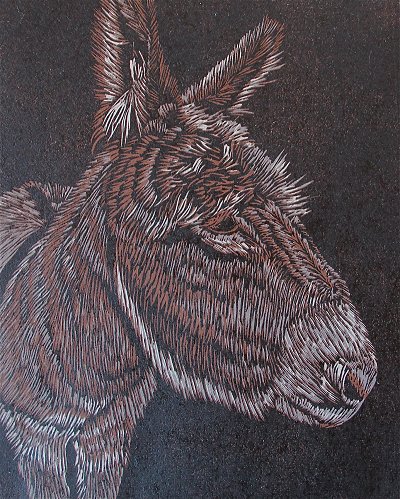
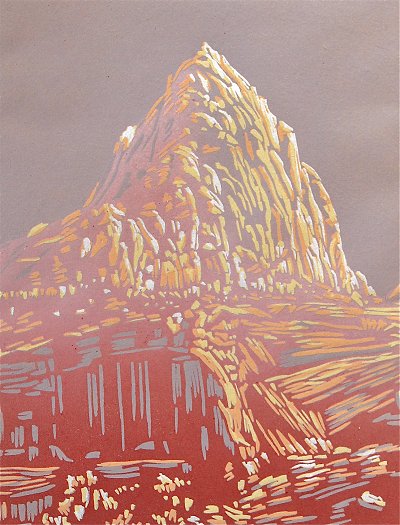
I carve a collection of textural, dimensional lines which is transformed by reduction printing into shapes, specks of hues, shadows and layers. This interplay of lines and layers of color is a blending ultimately of part representational, part abstraction.
My designs are all original, hand carved and hand printed on handmade Japanese paper in 5-7 different colors. This means that each print is printed 5-7 times, depending on how many colors are in each print. The block has to be registered 5-7 times to successfully have all the layers to match up in the final print. Each edition of 5 or 6 prints per block takes 1-2 weeks to complete.
My work is a compilation of my emotional connection to the Western and Southwestern landscape, flora and fauna from over 30 years of backcountry exploration and observation.
What is Relief Block Printing?
In relief block printing, the artist draws a design on a smooth block of material—usually wood or linoleum—and uses tools to carefully cut away the areas that are not to be printed, leaving behind a raised surface of lines and shapes. The surface of the block is inked using a roller. The inked block is carefully centered on to the paper which has been dampened ahead of time to accept the ink completely. The paper and block is either hand rubbed or put through a hand cranked press. All of these prints are printed one at a time. This is not digital art which is made or printed on a computer. This is traditional block printing.
What is Reductive Block Printing?
This time consuming and complex form of printing involves layering colors from a single block by slowly reducing the block with multiple carvings and printings. Every color is printed separately so the limited edition has to be printed all at the same time. Also the block has to be registered every time a new colored layer is printed. One block print can take as much as 1-2 weeks with drying times.
  |
   |
|
Opening
Reception September 18, 2026 ~ 5 PM - 7 PM Cortez Cultural Center 25 N. Market Street, Cortez . Open Studio Tour September 19 & 20, 2026 ~ 10 AM - 4 PM September 26 & 27, 2026 ~ 10 AM - 4 PM Check out the Tour Schedule page for more details and the 2026 Artists page to see which studios are open on each weekend.  |
Brought to you by: |